
Beware the Evil Weevil

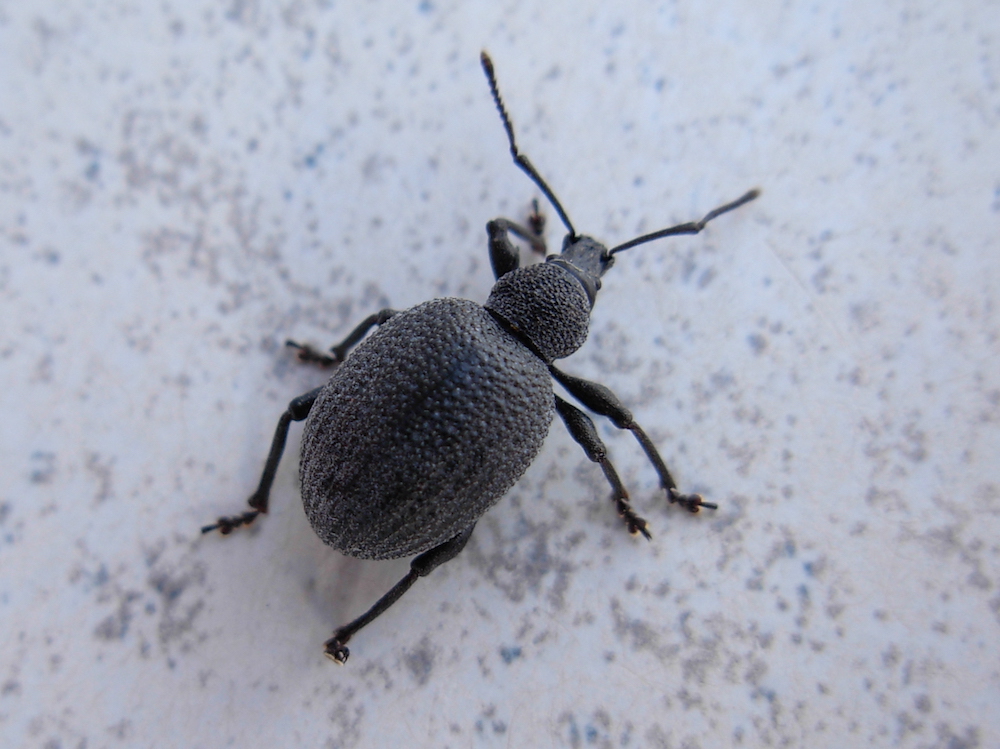
Image: Steve Bradley
The black vine weevil has emerged as one of the most significant and destructive pests affecting ornamental plants. Its ability to infest various species, combined with its resilience and rapid spread makes effective management and control of this pest increasingly important.
How to recognise the adult
Adults are approximately 1cm long with black bodies (sometimes slightly speckled yellow) with distinctive large antennae. They have no wings and are nocturnal, hiding during the day and feeding at night. Adult females feed on the edges of leaves, leaving distinctive half-moon notches around leaf margins before they lay their eggs close to the base of the host plant. About 80% of these are laid in October.
How to recognise the larvae
Larvae are legless, with glossy orange/brown heads. The body colour can vary from white through to pale pink, depending on the food source. When fully grown they are 1 - 1.5cm long, plump and often curled into a C-shape.
The larvae hatch from eggs after about two weeks. When young, they feed on the small, outer roots of plants. As they develop, they can digest woodier tissue and will graze on the bark of woody stems, burrow into root systems and mine into fleshier parts, such as begonia and cyclamen corms. The damage they cause can show as stunted growth, but their presence can go unnoticed until leaves or whole plants wilt suddenly.
Treatment 1: biological control
Several products based on nematodes are available, which can be applied as a drench using a watering can. The nematodes release a bacteria into the larva that kills it and breaks down its tissue for the nematodes to digest. A new generation of nematodes is produced inside the larva’s body that leave in search of more larvae.
These can be used in the garden soil and also very effective in containers. Some of these nematodes have different temperature requirements to survive and be effective, so do check before you purchase them. Some need a soil / compost temperature of 12C or higher, while others work at temperatures of 5C. Nematodes can persist for four-to-six weeks in consistently moist soil and compost.
Treatment 2: chemical control
BugClear Ultra Vine Weevil Killer (which contains acetamiprid) can be applied as a drench using a watering can, but should only be applied to ornamental plants growing in hanging baskets, pots and containers. Nematodes can persist for four-to-six weeks in consistently moist soils and composts.